
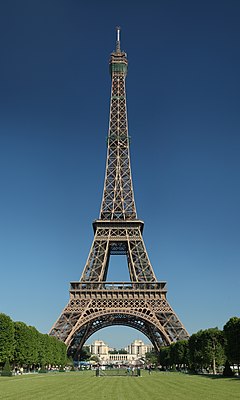
The Eiffel tower history represents a part of national heritage. It’s as been the symbol of France and Paris for decades. But when Gustave Eiffel achived its construction in 1889, the tower was only meant to be temporary in the Parisian landscape and was far from being the parisians’ favourite landmark. Discover the evolution and the history of the Paris Eiffel Tower.
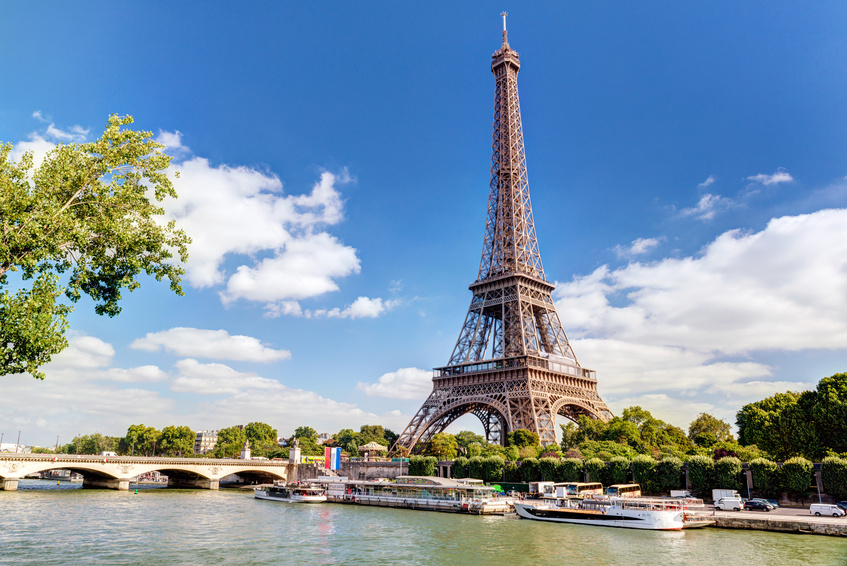

Origin
The design of the Eiffel Tower is attributed to Maurice Koechlin and Émile Nouguier, two senior engineers working for the Compagnie des Établissements Eiffel. It was envisioned after discussion about a suitable centrepiece for the proposed 1889 Exposition Universelle, a world’s fair to celebrate the centennial of the French Revolution. Eiffel openly acknowledged that inspiration for a tower came from the Latting Observatory built in New York City in 1853. In May 1884, working at home, Koechlin made a sketch of their idea, described by him as “a great pylon, consisting of four lattice girders standing apart at the base and coming together at the top, joined together by metal trusses at regular intervals”. Eiffel initially showed little enthusiasm, but he did approve further study, and the two engineers then asked Stephen Sauvestre, the head of company’s architectural department, to contribute to the design. Sauvestre added decorative arches to the base of the tower, a glass pavilion to the first level, and other embellishments.
First drawing of the Eiffel Tower by Maurice Koechlin including size comparison with other Parisian landmarks such as Notre Dame de Paris, the Statue of Liberty and the Vendôme Column
The new version gained Eiffel’s support: he bought the rights to the patent on the design which Koechlin, Nougier, and Sauvestre had taken out, and the design was exhibited at the Exhibition of Decorative Arts in the autumn of 1884 under the company name. On 30 March 1885, Eiffel presented his plans to the Société des Ingénieurs Civils; after discussing the technical problems and emphasising the practical uses of the tower, he finished his talk by saying the tower would symbolise,
Not only the art of the modern engineer, but also the century of Industry and Science in which we are living, and for which the way was prepared by the great scientific movement of the eighteenth century and by the Revolution of 1789, to which this monument will be built as an expression of France’s gratitude.
Little progress was made until 1886, when Jules Grévy was re-elected as president of France and Édouard Lockroy was appointed as minister for trade. A budget for the exposition was passed and, on 1 May, Lockroy announced an alteration to the terms of the open competition being held for a centrepiece to the exposition, which effectively made the selection of Eiffel’s design a foregone conclusion, as entries had to include a study for a 300 m (980 ft) four-sided metal tower on the Champ de Mars. (A 300-meter tower was then considered a herculean engineering effort). On 12 May, a commission was set up to examine Eiffel’s scheme and its rivals, which, a month later, decided that all the proposals except Eiffel’s were either impractical or lacking in details.
After some debate about the exact location of the tower, a contract was signed on 8 January 1887. This was signed by Eiffel acting in his own capacity rather than as the representative of his company, and granted him 1.5 million francs toward the construction costs: less than a quarter of the estimated 6.5 million francs. Eiffel was to receive all income from the commercial exploitation of the tower during the exhibition and for the next 20 years. He later established a separate company to manage the tower, putting up half the necessary capital himself.
Construction
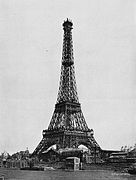
Foundations of the Eiffel Tower
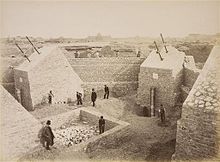
Work on the foundations started on 28 January 1887. Those for the east and south legs were straightforward, with each leg resting on four 2 m (6.6 ft) concrete slabs, one for each of the principal girders of each leg. The west and north legs, being closer to the river Seine, were more complicated: each slab needed two piles installed by using compressed-air caissons 15 m (49 ft) long and 6 m (20 ft) in diameter driven to a depth of 22 m (72 ft) to support the concrete slabs, which were 6 m (20 ft) thick. Each of these slabs supported a block of limestone with an inclined top to bear a supporting shoe for the ironwork.
Each shoe was anchored to the stonework by a pair of bolts 10 cm (4 in) in diameter and 7.5 m (25 ft) long. The foundations were completed on 30 June, and the erection of the ironwork began. The visible work on-site was complemented by the enormous amount of exacting preparatory work that took place behind the scenes: the drawing office produced 1,700 general drawings and 3,629 detailed drawings of the 18,038 different parts needed. The task of drawing the components was complicated by the complex angles involved in the design and the degree of precision required: the position of rivet holes was specified to within 1 mm (0.04 in) and angles worked out to one second of arc[18]. The finished components, some already riveted together into sub-assemblies, arrived on horse-drawn carts from a factory in the nearby Parisian suburb of Levallois-Perret and were first bolted together, with the bolts being replaced with rivets as construction progressed. No drilling or shaping was done on site: if any part did not fit, it was sent back to the factory for alteration. In all, 18,038 pieces were joined together using 2.5 million rivets.
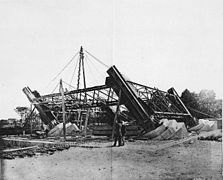
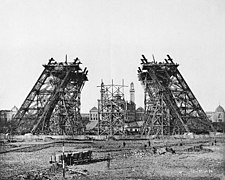
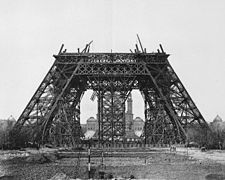
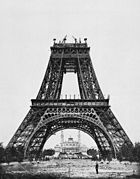
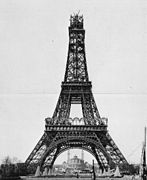
At first the legs were constructed as cantilevers, but about halfway to the first level, construction was paused in order to create a substantial timber scaffold. This renewed concerns about the structural integrity of the tower, and sensational headlines such as “Eiffel Suicide!” and “Gustave Eiffel Has Gone Mad: He Has Been Confined in an Asylum” appeared in the tabloid press. At this stage, a small “creeper” crane designed to move up the tower was installed in each leg. They made use of the guides for the lifts which were to be fitted in the four legs. The critical stage of joining the legs at the first level was completed by the end of March 1888. Although the metalwork had been prepared with the utmost attention to detail, provision had been made to carry out small adjustments in order to precisely align the legs; hydraulic jacks were fitted to the shoes at the base of each leg, capable of exerting a force of 800 tonnes, and the legs were intentionally constructed at a slightly steeper angle than necessary, being supported by sandboxes on the scaffold. Although construction involved 300 on-site employees, only one person died, due to Eiffel’s safety precautions and the use of movable gangways, guardrails and screens.

Lifts
The Roux, Combaluzier & Lepape lifts during construction. Note the drive sprockets and chain in the foreground.
Equipping the tower with adequate and safe passenger lifts was a major concern of the government commission overseeing the Exposition. Although some visitors could be expected to climb to the first level, or even the second, lifts clearly had to be the main means of ascent.

Constructing lifts to reach the first level was relatively straightforward: the legs were wide enough at the bottom and so nearly straight that they could contain a straight track, and a contract was given to the French company Roux, Combaluzier & Lepape for two lifts to be fitted in the east and west legs.[22] Roux, Combaluzier & Lepape used a pair of endless chains with rigid, articulated links to which the car was attached. Lead weights on some links of the upper or return sections of the chains counterbalanced most of the car’s weight. The car was pushed up from below, not pulled up from above: to prevent the chain buckling, it was enclosed in a conduit. At the bottom of the run, the chains passed around 3.9 m (12 ft 10 in) diameter sprockets. Smaller sprockets at the top guided the chains.
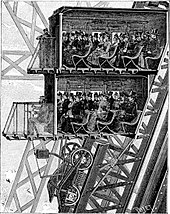
The Otis lifts originally fitted in the north and south legs
Installing lifts to the second level was more of a challenge because a straight track was impossible. No French company wanted to undertake the work. The European branch of Otis Brothers & Company submitted a proposal but this was rejected: the fair’s charter ruled out the use of any foreign material in the construction of the tower. The deadline for bids was extended but still no French companies put themselves forward, and eventually the contract was given to Otis in July 1887. Otis were confident they would eventually be given the contract and had already started creating designs.
The car was divided into two superimposed compartments, each holding 25 passengers, with the lift operator occupying an exterior platform on the first level. Motive power was provided by an inclined hydraulic ram 12.67 m (41 ft 7 in) long and 96.5 cm (38.0 in) in diameter in the tower leg with a stroke of 10.83 m (35 ft 6 in): this moved a carriage carrying six sheaves. Five fixed sheaves were mounted higher up the leg, producing an arrangement similar to a block and tackle but acting in reverse, multiplying the stroke of the piston rather than the force generated. The hydraulic pressure in the driving cylinder was produced by a large open reservoir on the second level. After being exhausted from the cylinder, the water was pumped back up to the reservoir by two pumps in the machinery room at the base of the south leg. This reservoir also provided power to the lifts to the first level.
The original lifts for the journey between the second and third levels were supplied by Léon Edoux. A pair of 81 m (266 ft) hydraulic rams were mounted on the second level, reaching nearly halfway up to the third level. One lift car was mounted on top of these rams: cables ran from the top of this car up to sheaves on the third level and back down to a second car. Each car only travelled half the distance between the second and third levels and passengers were required to change lifts halfway by means of a short gangway. The 10-ton cars each held 65 passengers.
 Hospitality And Tourism